←In the Heart of Nizhny

In the Heart of Nizhny

Photo of route “In the Heart of Nizhny”
Photo of route “In the Heart of Nizhny” — 2
Photo of route “In the Heart of Nizhny” — 3
Photo of route “In the Heart of Nizhny” — 4
14 points2 km3 hours

Many consider Minin Square the heart of Nizhny Novgorod. It's the historic center, home to many of the city's famous landmarks. Here too is the main entrance to the Nizhny Novgorod Kremlin, where the city began to grow in 1221. The city's main pedestrian street, Bolshaya Pokrovskaya, leads to the central square, and this route is devoted to it. On the tour you'll see buildings of different eras and styles, learn intriguing legends and facts about the street, take great photos, and get to know the city.

Things to do

  • 📜 Learn the city's history
  • 👀 Watch city life

Route points (14)

  1. Oktyabr Cinema — point on route “In the Heart of Nizhny”

    Oktyabr Cinema

    💭🌱 Pause and reflect · 📜 Historic site

  2. Oktyabr Cinema

    Points will be available after purchasing the route

  3. City Duma Building — point on route “In the Heart of Nizhny”

    City Duma Building

    📸 Take photos · 🏟️ Architectural landmark

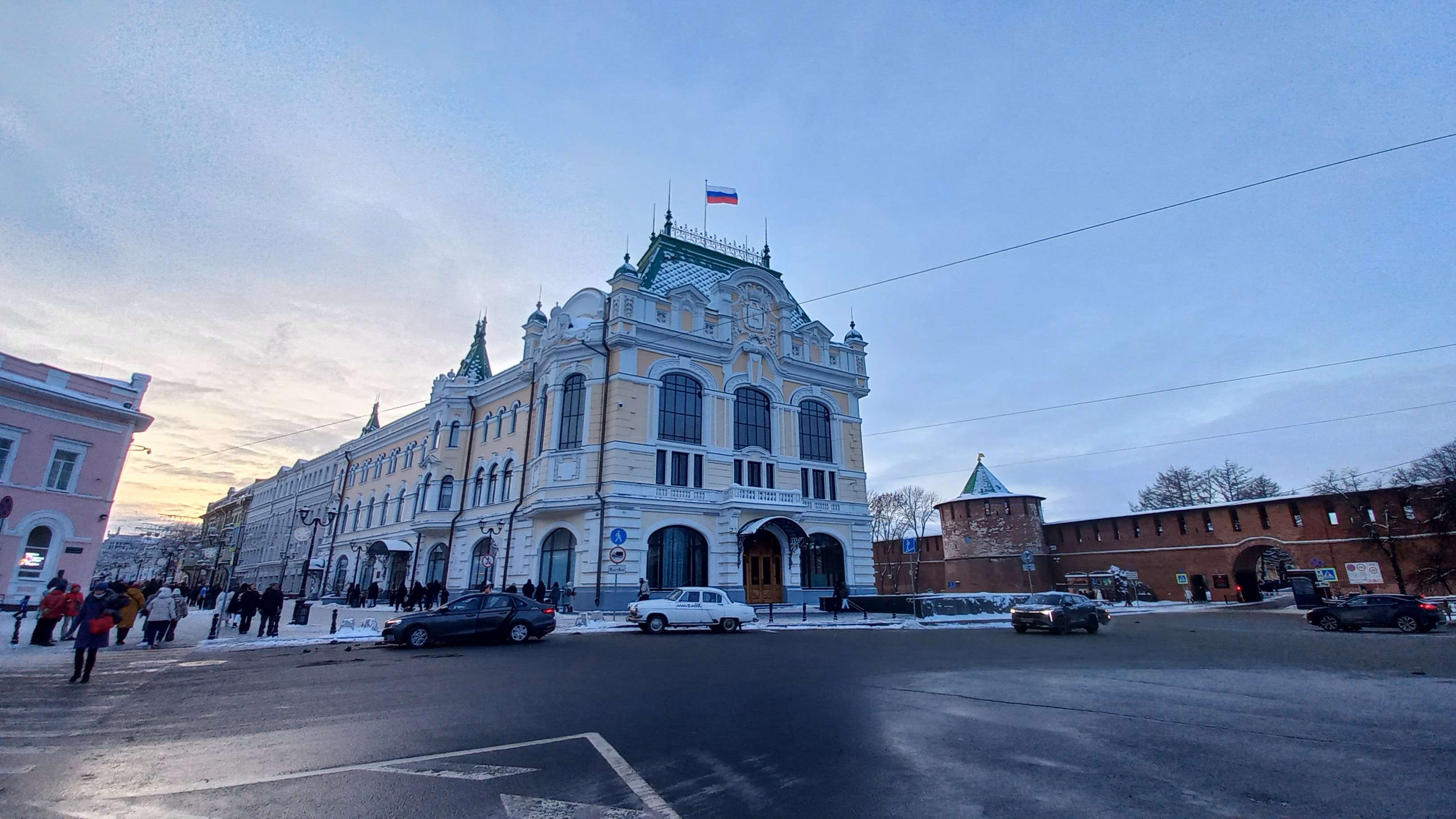
City Duma Building in Nizhny Novgorod

Point on route “In the Heart of Nizhny”

City Duma Building — point on route “In the Heart of Nizhny”

Point 14

City Duma Building

📸 Take photos • 🏟️ Architectural landmark

Construction History

The Nizhny Novgorod City Duma building is a landmark of urban planning and architecture in the city's historic center. It was built in 1899–1904. The foundations were laid on September 12, 1901. In 1902 the shell of the building was completed and covered with an iron roof. In 1903–1904, under the supervision of the architect N. M. Veshnyakov, the interiors were finished: the oak paneling and suspended ceilings were made by the joiner N. Kiselnikov, and the ceiling paintings by the painter S. Fyodorov. The Duma building was consecrated on April 18, 1904. In 1908 the assembly hall was adorned with the emperor's gift to the city, the famous huge canvas “Minin's Appeal” by Konstantin Makovsky.

Architectural Features

The building was erected in the early period of Art Nouveau in Russian architecture and combines features of academic eclecticism and decorative Art Nouveau. The initial designs were in the lavish Baroque-eclectic forms of the French Renaissance. The final version showed the influence of the Romantic Art Nouveau then emerging in Nizhny Novgorod: the curving forms of the cornice, parapets, and huge windows of the vestibule and assembly hall; bay windows, towers, and turrets; equally careful treatment of all facades, including those facing the courtyard; outer forms reflecting the interior layout; extensive use of wood in the interior decoration; and smooth three-centered arches.

The Soviet Years and Today

In Soviet times the building was renamed first the House of Unions and then the Palace of Labor. It housed representatives of the Provisional Government and the City Duma, the Nizhny Novgorod Soviet city administration, and the Council of Trade Unions; in 1946, 32 regional trade union committees, the office of the representative of the All-Union Central Council of Trade Unions, and other organizations under the trade unions moved in. Today the building belongs to the Arbitration Court of the Volga-Vyatka District.