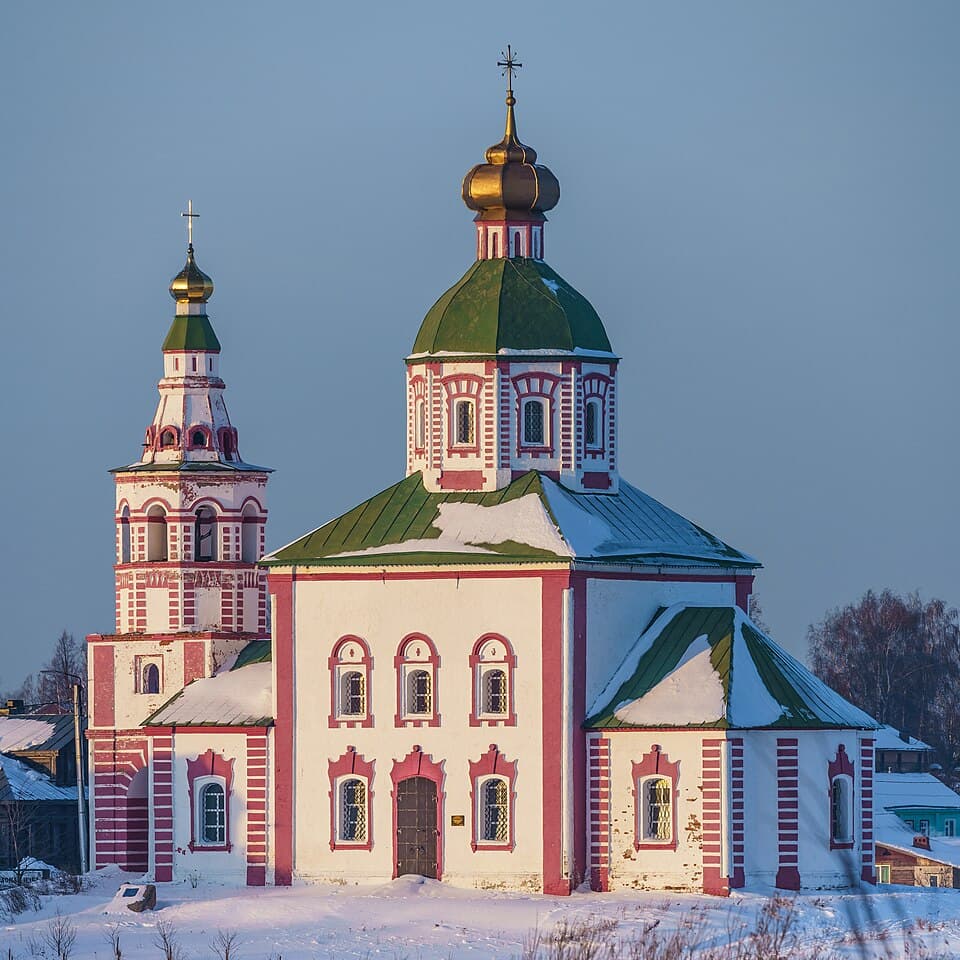
Historical Background
The Church of the Prophet Elijah stands on a high hill called Ivanova Gora (Ivan's Hill). It is one of the most picturesque spots in Suzdal, with a view of the whole kremlin, the Intercession and Savior-Euthymius monasteries, the Kamenka River, and the water meadows. The church was built in 1744 on the site of an older wooden church mentioned as early as the 17th century. It was commissioned by local merchants and townspeople, residents of Zarechye, the part of town on the left bank of the Kamenka.
The site for the church was not chosen by chance. Ivanova Gora is not just a pretty hill. According to tradition, it was here in 1216 that the Battle of Lipitsa took place, one of the bloodiest internecine battles of early Rus. The men of Vladimir and Suzdal fought against the men of Novgorod and Smolensk, and thousands died. The Church of the Prophet Elijah, built five centuries later, became a kind of prayerful memorial to those tragic events.
In Soviet times the church, like many in Suzdal, was closed. The building was used as a warehouse and then simply abandoned. In the 1970s it was restored (the dome, roof, and facades were repaired), but it was not given back to believers: it became a concert hall and exhibition space. In the 1990s the church was at last returned to the Russian Orthodox Church, but services are held here irregularly: there is no parish, and the church is assigned to the Savior-Euthymius Monastery, which does not have many priests.
Architecture
The Church of the Prophet Elijah is a classic example of mid-18th-century Suzdal Baroque. It is a pillarless single-domed cube with a refectory and a tent-roofed bell tower, extended along a west–east axis (the so-called “ship” layout). The main volume is tall and light, with large windows. The dome sits on a slender drum and is covered with lemekh (wooden shingles). The facades are adorned with modest stucco decoration: window surrounds with “ears,” cornices, and rusticated corners.
The refectory is wide and low, with two tiers of windows. Parishioners once gathered here after services for conversation and meals. The bell tower is tent-roofed and octagonal, with three tiers of bells. The tent ends in a small dome with a cross. The bell tower held 6 bells, the largest weighing 50 poods (800 kilograms, or 1,760 pounds). In Soviet times the bells were thrown down and broken. Today new bells hang there, cast in the 2000s.
Inside, the church is spacious, with good acoustics. The floor is made of cast-iron slabs (rare for Suzdal, where floors are usually stone or wood). The walls are whitewashed; there are no frescoes, only icons in the iconostasis and on the walls. The iconostasis is wooden, carved, gilded, and dates from the 19th century. The main icons are Christ Pantocrator, the Prophet Elijah in the Wilderness, and the Kazan Mother of God.
The Site of the Battle of Lipitsa
Ivanova Gora is not just a pretty hill. It is the place where, in 1216, a battle took place in which Russian princes killed one another with particular ferocity. On one side was the Vladimir-Suzdal army of Prince Yuri Vsevolodovich (the very Yuri who later founded Nizhny Novgorod). On the other was the Novgorod-Smolensk host of Prince Mstislav the Bold, joined by the exiled Prince Konstantin Vsevolodovich of Rostov.
The battle was terrible. The chroniclers write that “the slaughter was fierce, and the cries of the living and the groans of the dying drowned out the noise of battle.” By various estimates, between 2,000 and 5,000 people died, colossal losses for the 13th century. Mstislav the Bold won. Yuri Vsevolodovich was forced to cede the Principality of Vladimir to his brother Konstantin.
For the Church, the Battle of Lipitsa is an example of how the sin of internecine strife destroys the Russian land. It is no accident that the church built here five centuries later was dedicated to the Prophet Elijah, one of the most formidable Old Testament prophets, who denounced kings for their iniquities. This place is a warning to all rulers: do not feud among yourselves, do not shed your brothers' blood.
Shrines and Special Features
The church's main shrine is an icon of the Prophet Elijah which, according to tradition, was found on Ivanova Gora after the Battle of Lipitsa. Legend has it that one of the surviving warriors saw an image of the Prophet Elijah hovering in the air over the battlefield. He took the icon and carried it to the nearest village. From then on the image was considered miracle-working, especially in times of drought, when people came to it to pray for rain. Sadly, that ancient icon has not survived. The one in the church today is a 19th-century copy, but it too is venerated.
The church also keeps an old Gospel book of 1689 (in a silver cover, with clasps). It was given to the church by parishioners in memory of their ancestors who fell at Lipitsa. The flyleaf bears an inscription: “This book was given to the Church of the Prophet Elijah by the townsman Ivan Zakharov for the eternal remembrance of his soul and of his forebears, who perished by the sword on this spot in the year 1216.” The Gospel book is used during the rare services.
Myths and Legends
The main legend of Ivanova Gora is about the “Lipitsa treasure.” Supposedly after the battle the victors did not bury the dead (there was neither time nor anyone to do it) but simply threw them into the ravines and covered them with earth. Along with the bodies, weapons, armor, and even gold (princely ornaments and money) went into the ground. It is said that sometimes after heavy rains, when the soil washes away, skulls and bones wash out of the ravines, and with them ancient coins and arrowheads. Treasure hunters have tried digging, but each time something got in the way: a landslide, a strange illness, nightmares. Locals say, “Don't disturb the dead.”
Another legend is about a phantom army. On the night of June 21 (on the eve of the summer solstice), shadows of warriors supposedly appear on Ivanova Gora. They stand in silence and then suddenly begin to fight, and you can hear the clash of swords, cries, and groans. But after a few minutes everything vanishes. The Church interprets this as souls that cannot find rest: the unbaptized or unburied warriors repeat their sin again and again. That is why priests sometimes hold a memorial service here “for all those slain in battle.”
A third legend concerns the origin of the name Ivanova Gora. Supposedly, long before the battle, a holy hermit named John (Ivan) lived here: a boyar who had given away his estate and withdrawn into the wilderness. He prayed on this hill for the town of Suzdal. After his death the hill was named Ivanova Gora. And when a church was built 300 years later, it was dedicated to the Prophet Elijah, but the popular name “Ivan's Church” stuck. There is no historical confirmation of this, but it's a beautiful legend.
Today
The Church of the Prophet Elijah is a working church, but services are held irregularly. On ordinary days it is closed. To get inside, you need either to come to a service or to arrange a tour with the monastery. But even if you don't get in, the place itself is worth a visit.
Ivanova Gora is one of the best viewpoints in Suzdal. From here you can see the whole kremlin, all the monasteries, the Kamenka River, and the meadows. People come here to watch the sunset (on the west side) and the sunrise (on the east). Below the hill, a stream flows into the Kamenka. In summer children swim here, and in winter they go sledding. The place is very lively, not museum-like, real.

 10 points
 6 km
 2.5 hours