Historical Background
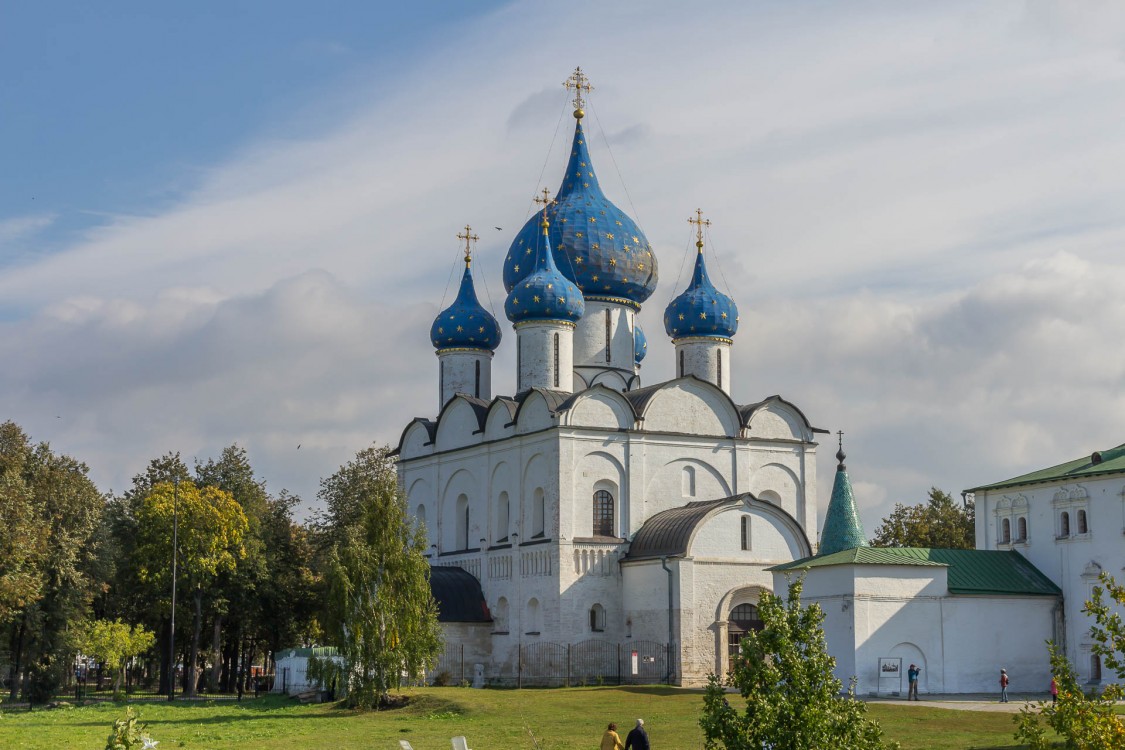
The Cathedral of the Nativity of the Most Holy Mother of God is the oldest surviving building in Suzdal and the heart of the Suzdal kremlin. The first church on this site was founded by Vladimir Monomakh at the end of the 11th century, but the white-stone building that has come down to us was erected in 1222–1225 under Prince Yuri Vsevolodovich. Originally the cathedral was taller and looked different: in the 13th century it was adorned with white-stone carving and recessed portals reminiscent of the churches of Vladimir.
In the 15th century the cathedral was badly damaged by fire, and in 1528–1530 it was rebuilt. The upper part of the walls was dismantled and rebuilt in brick, while the ancient white-stone lower part was kept. This gave the cathedral its unique two-tone masonry, still visible today. In the 17th century a tent-roofed bell tower was added, and in the 19th century a heated refectory church dedicated to the Dormition of the Most Holy Mother of God.
Architecture and Shrines
The cathedral's chief architectural ornament is its domes. Unlike the traditional gold or green ones, the domes of the Nativity Cathedral are bright blue with golden stars. This decoration, rare in Russian architecture, symbolizes the Mother of God, the Queen of Heaven, clothed in robes the color of the sky. The stars themselves recall the birth of Christ and the Star of Bethlehem that announced the coming of the Savior to the world.
Inside, fragments of 13th-century frescoes by an artel of Vladimir masters have survived. They are among the oldest wall paintings in Northeastern Rus. Pilgrims are especially drawn to the Golden Doors, the unique doors of the west portal made using the technique of fire gilding. The copper plates depict biblical scenes and figures of saints, and the method of making them was lost in the Middle Ages.
The Main Shrines
Hidden beneath the floor of the cathedral rest the relics of three holy bishops of Suzdal: St. John, St. Theodore, and St. Hilarion. These hierarchs governed the Suzdal see in the 13th–14th centuries and were venerated locally long before their church-wide glorification. Their holiness is confirmed by many miracles that took place at their tombs. Unfortunately, the exact place of burial is unknown today, but prayerful veneration of the saints has never ceased: by the cathedral walls you can always see pilgrims who have come to venerate the ancient saints of the Suzdal land.
The cathedral also has a revered copy of the Smolensk icon of the Mother of God and particles of the relics of many saints, sewn into the antimensia (cloths) of the altars.
Myths and Legends
One of the cathedral's main legends concerns its starry domes. The elders of Suzdal used to say that the image of the vault of heaven was created for a reason: the cathedral was conceived as an image of the cave of Bethlehem, and the stars were meant to remind people that a special grace is kept right here, in this town. It was also said that mirrors were originally set inside the domes, and on a sunny day the golden stars on the blue background reflected the light so that an unearthly radiance spread through the church.
Another tradition concerns the Golden Doors. They say that in the Time of Troubles, when the Poles tried to plunder the cathedral, the doors suddenly became heavy and would not give way, and such singing rang out from inside that the invaders fled in fear. Since then the doors have been considered miracle-working, and people come to them to pray for the protection of their home and family.
Today
Today the Cathedral of the Nativity of the Most Holy Mother of God is a working church and part of the Vladimir-Suzdal Museum-Reserve. Services are held here not daily but regularly, especially on patronal feasts and the feast days of the holy bishops of Suzdal. For pilgrims it is a must: this is where you begin to get to know Suzdal's heavenly patrons.
 10 points
 6 km
 2.5 hours