←Merchant Rybinsk

Merchant Rybinsk

Photo of route “Merchant Rybinsk”
12 points4 km3 hours

Since the 18th century Rybinsk has been an important stop on the route from the Volga region to the Baltic. Over its history it earned the title of “Russia's barge hauler capital,” the country's highest government bodies consulted the brokers of its exchange, and the town is also the birthplace of founders of Hollywood. Take a walk and discover the fascinating stories of this corner of “deep Russia”!

Things to do

  • 📜 Learn the city's history
  • 🏛️🕰️ Compare the eras

Route points (12)

  1. Rybinsk Railway Station — point on route “Merchant Rybinsk”

    Rybinsk Railway Station

    🚂 Railway station

  2. Artists' House — point on route “Merchant Rybinsk”

    Artists' House

    🏟️ Architectural landmark

  3. Polish Catholic Church of the Holy Jesus — point on route “Merchant Rybinsk”

    Polish Catholic Church of the Holy Jesus

    🕍 Place of worship

  4. Fire Watchtower — point on route “Merchant Rybinsk”

    Fire Watchtower

    ⚙️ Industrial site

  5. Rybinsk Embankment — point on route “Merchant Rybinsk”

    Rybinsk Embankment

    🚶‍♂️ Waterfront

  6. Chapel of St. Nicholas the Wonderworker — point on route “Merchant Rybinsk”

    Chapel of St. Nicholas the Wonderworker

    🕍 Place of worship

  7. Old Grain Exchange — point on route “Merchant Rybinsk”

    Old Grain Exchange

    🕵️ Urban legend

  8. New Grain Exchange (Museum-Reserve) — point on route “Merchant Rybinsk”

    New Grain Exchange (Museum-Reserve)

    🕵️ Urban legend

  9. Red Square — point on route “Merchant Rybinsk”

    Red Square

    ⛲ Square

  10. Cathedral of the Transfiguration of the Savior — point on route “Merchant Rybinsk”

    Cathedral of the Transfiguration of the Savior

    🕍 Place of worship

  11. The Nobels and the Nobel Movement — point on route “Merchant Rybinsk”

    The Nobels and the Nobel Movement

    🏛️ Museum · 🌿 Public garden or park

  12. Sigson Family House — point on route “Merchant Rybinsk”

    Sigson Family House

    🏟️ Architectural landmark

Old Grain Exchange in Rybinsk

Point on route “Merchant Rybinsk”

Old Grain Exchange — point on route “Merchant Rybinsk”

Point 7

Old Grain Exchange

🕵️ Urban legend

Historical Background

This area isn't famous for wheat fields, so why a grain exchange here? The answer is simple: Rybinsk was a major transshipment point on the upper Volga, through which grain from the Lower Volga traveled to the new capital, St. Petersburg. In the 18th century Rybinsk was a key link in the waterway system connecting the Volga and the Baltic Sea. In 1870, with the arrival of the railroad, Rybinsk's role as a transshipment point only grew.

The First Grain Exchange in Provincial Russia

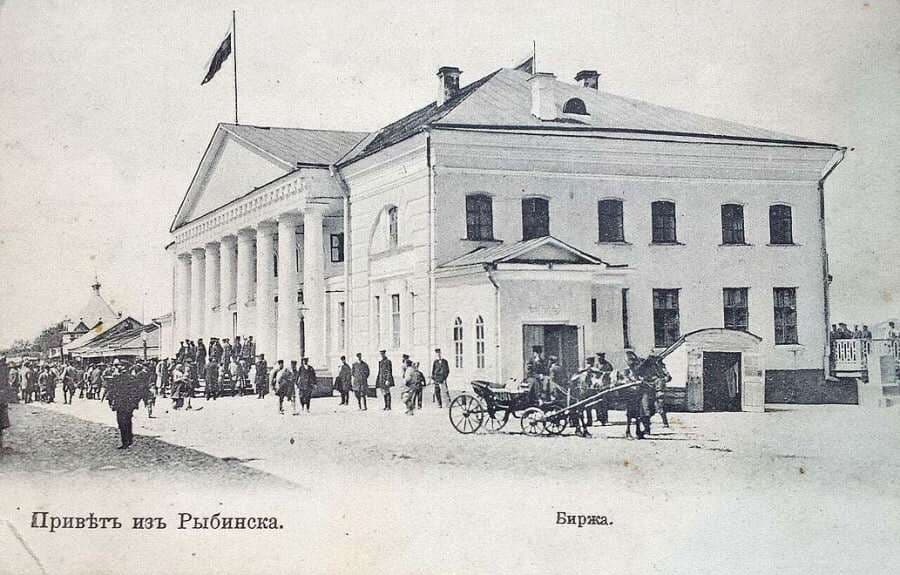
The Old Grain Exchange, also called the “Pilot” Exchange, stands modestly next to the new one, which looks more like a palace. It's easy to miss, but don't pass it by: this eight-columned building is the first grain exchange in provincial Russia and the third in the country, after those in Moscow and St. Petersburg!

Years of Idleness

The exchange was built in 1811 with money from the town treasury and from out-of-town merchants who made deals here. Usually deals were struck in taverns over a cup of tea, which evidently some found inconvenient. But after the opening it turned out that the merchants didn't want to change their old habits, so nobody needed the exchange. For a long time the building was used first by the City Duma and then by the district and Zemstvo courts. Even the initiative of Nicholas I, who ordered the exchange reopened, didn't persuade the merchants to use it.

Half a Century of Glory

In 1860 the merchant Mikhail Zhuravlev became chairman of the exchange committee. He convinced the businessmen of the advantages of using the exchange and gradually built up its authority. Thanks to Zhuravlev, the Rybinsk Grain Exchange became the largest in Russia. Even the highest government bodies asked its opinion on various economic matters, and the 1% of profits paid out by the bank amounted to 1 million rubles, a huge sum for the provinces in those days. In time the merchants outgrew its walls, and a new building was needed.