←Literary Pages of Tver

Literary Pages of Tver

Photo of route “Literary Pages of Tver”
16 points4 km4 hours

Join us for a walk along the embankment and the central streets, and recall how great and forgotten poets, prose writers, and publishers of other centuries saw this beauty: Alexander Pushkin, Alexander Ostrovsky, Ivan Turgenev, Fyodor Dostoevsky, and many others. They declared their love for “dear,” “beautiful” Tver and dedicated their finest lines to it.

Things to do

  • 📚🎬 Recall films and books
  • 📜 Learn the city's history

Route points (16)

  1. I. A. Krylov Monument — point on route “Literary Pages of Tver”

    I. A. Krylov Monument

    🗿 Monument

  2. Tver Commercial School for Girls — point on route “Literary Pages of Tver”

    Tver Commercial School for Girls

    🏟️ Architectural landmark · 📜 Historic site

  3. Travel Palace — point on route “Literary Pages of Tver”

    Travel Palace

    🏰 Palace · 📜 Historic site · 🏟️ Architectural landmark

  4. Ivan Petrovich Wulf's House — point on route “Literary Pages of Tver”

    Ivan Petrovich Wulf's House

    🏟️ Architectural landmark · 📜 Historic site

  5. Assembly of the Nobility Building — point on route “Literary Pages of Tver”

    Assembly of the Nobility Building

    🏟️ Architectural landmark · 📜 Historic site

  6. A. S. Pushkin Memorial Bust — point on route “Literary Pages of Tver”

    A. S. Pushkin Memorial Bust

    🗿 Monument

  7. Regional Drama Theater — point on route “Literary Pages of Tver”

    Regional Drama Theater

    🎭 Theater · 🏟️ Architectural landmark

  8. Merchant Barsukov's Hotel — point on route “Literary Pages of Tver”

    Merchant Barsukov's Hotel

    📜 Historic site · 🏟️ Architectural landmark

  9. Magistracy Building — point on route “Literary Pages of Tver”

    Magistracy Building

    🏟️ Architectural landmark · 📜 Historic site

  10. Former Tver Gymnasium for Boys — point on route “Literary Pages of Tver”

    Former Tver Gymnasium for Boys

    📜 Historic site · 🏟️ Architectural landmark

  11. Former Galiani Hotel — point on route “Literary Pages of Tver”

    Former Galiani Hotel

    📜 Historic site

  12. Andrei Dementyev House of Poetry — point on route “Literary Pages of Tver”

    Andrei Dementyev House of Poetry

    🏟️ Architectural landmark

  13. F. N. Glinka's House — point on route “Literary Pages of Tver”

    F. N. Glinka's House

    📜 Historic site

  14. Felicità Restaurant — point on route “Literary Pages of Tver”

    Felicità Restaurant

    🕵️ Urban legend · 📜 Historic site

  15. B. N. Polevoy's House — point on route “Literary Pages of Tver”

    B. N. Polevoy's House

    📜 Historic site

  16. M. E. Saltykov-Shchedrin Monument — point on route “Literary Pages of Tver”

    M. E. Saltykov-Shchedrin Monument

    🗿 Monument

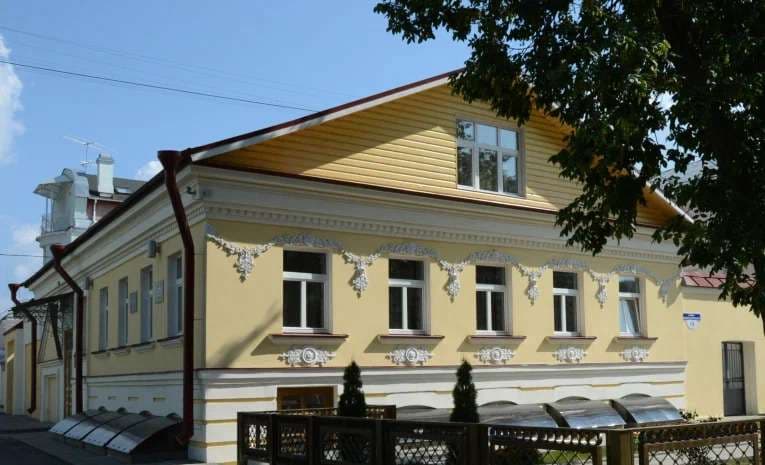
Andrei Dementyev House of Poetry in Tver

Point on route “Literary Pages of Tver”

Andrei Dementyev House of Poetry — point on route “Literary Pages of Tver”

Point 12

Andrei Dementyev House of Poetry

🏟️ Architectural landmark

Historical Background

On July 20, 2013, Russia's first House of Poetry opened in Tver, named after Andrei Dementyev, the famous poet, a native of Tver, and an honorary citizen of the city and of Tver Region. As the master himself conceived it, this is more than just a museum.

About Andrei Dementyev

Andrei Dmitrievich Dementyev was born on July 16, 1928. Many years of the poet's life were bound up with the Tver land: he was born here, finished secondary school here, and studied at the Kalinin Pedagogical Institute. The writer was editor-in-chief of the magazine Yunost (Youth).

Architectural Features

The House of Poetry is located on Andrei Dementyev Street in an old mansion from the late Classical era. Zurab Tsereteli, president of the Russian Academy of Arts, created a series of sculptural portraits of Russian poets especially for its interiors. In 2016, on the House of Poetry's birthday, Zurab Tsereteli presented it with a monument to the poets of the Sixties generation. It is the first monument to this generation of innovative poets. The monument takes the form of a bookshelf holding books bearing the poets' names.