Historical Background
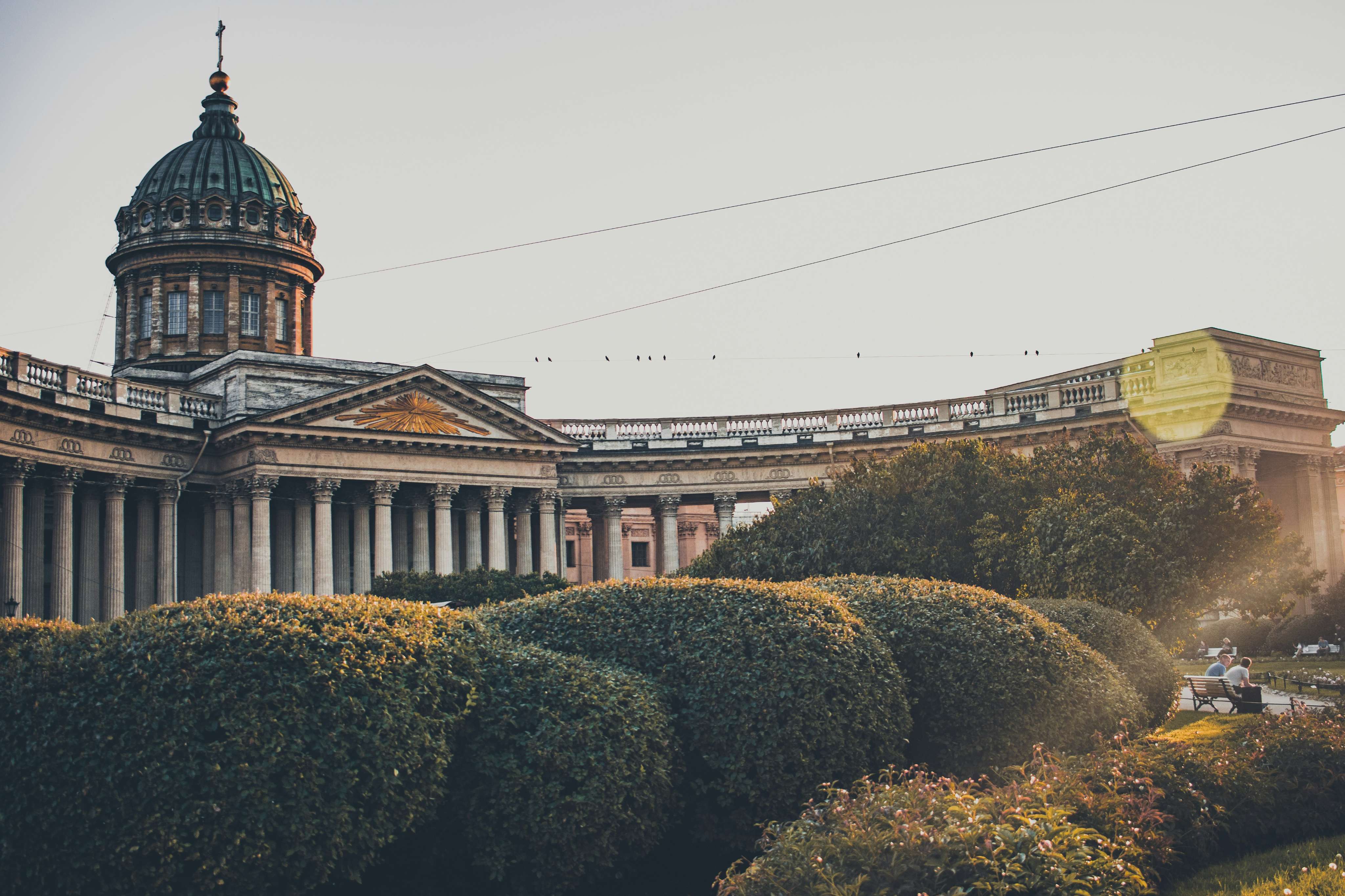
Kazan Cathedral is one of the largest and most grandiose churches in St. Petersburg and the whole country. It was built on Nevsky Prospekt in 1801–1811 by the architect Andrei Voronikhin. If the church reminds you of St. Peter's Basilica in the Vatican, that's no accident: Kazan Cathedral was conceived that way at the suggestion of Paul I. Before the grand construction project, a small Church of the Nativity of the Mother of God stood on this site. In the late 18th century, when Pavel Petrovich was heir to the throne and traveled in Europe, he wrote enthusiastically from Rome about the grandeur of St. Peter's.
In 1799 the emperor issued a decree announcing an architectural competition in which many prominent European architects took part. Charles Cameron was named the winner, but a few days later the emperor revoked his decision, and the competition was left without a winner. A year later Count Alexander Stroganov lobbied for his protégé, the former serf Andrei Voronikhin. The count had sent him to study architecture first in Moscow and then, after granting him his freedom, in Paris and Geneva. In the end Voronikhin was confirmed as the cathedral's chief architect, and Count Stroganov became head of the board of trustees for the construction.
The church was completed in 1811. A year later, after the end of the Patriotic War of 1812 against the French, the cathedral became a monument to Russian military glory. In 1813 the commander Mikhail Illarionovich Kutuzov was buried here, and the keys of captured cities and other war trophies were placed inside.
In the Soviet period many churches suffered, but Kazan Cathedral escaped that fate in the most unexpected way: the Museum of the History of Religion and Atheism was opened inside. After the collapse of the USSR, the museum and the church coexisted within its walls for several more years. Since 2000 it has been a cathedral.
Architectural and Religious Details
It was not by chance that the heir to the throne, Pavel Petrovich, chose St. Peter's as his architectural model. He had the idea of uniting the two branches of the Christian faith. He had been a guest of the Pope and was obsessed with stories of the Knights of Malta. Hence the attempt to create a church that would resemble the Vatican's main basilica and become a kind of bridge between Orthodoxy and Catholicism.
But Paul I did not live to see all this splendor. He approved the design, but the new church was founded in August 1801, when Alexander I was already emperor.
The chief architect, Voronikhin, did not particularly support the comparison with St. Peter's. Yes, that was the original brief, but Voronikhin himself named as the prototypes of his composition St. Paul's Cathedral in London, Santa Maria delle Grazie in Milan, St. Mark's Basilica in Venice, and the Church of Sainte-Geneviève (the Panthéon) in Paris.
The main difficulty lay in church canon: the main facade and entrance had to be on the west side. But according to the plan, the cathedral's ceremonial side had to face Nevsky Prospekt, which meant the composition would open to the north. Voronikhin solved the problem by framing the square facing Nevsky with a semicircular colonnade. Kazan Cathedral received 96 columns of Pudost travertine set in four rows.
This colonnade looks as if the cathedral wants to open up to something new, its arms flung wide. By comparison, St. Peter's in Rome has 284 travertine columns in four rows, and there the effect is the opposite: Gian Lorenzo Bernini's colonnade surrounds you, as if the Catholic faith were enveloping and embracing you.
Construction was completed in 1811, and that same year Andrei Voronikhin was awarded the Order of St. Vladimir, 4th class. Finishing work inside the church continued for about 4 more years.
Nearby
Kazan Square
Most of the square is taken up by the monumental cathedral, but in front of it there is a small garden with a fountain. In 1837 monuments to two outstanding Russian commanders, Kutuzov and Barclay de Tolly, were unveiled on either side of the garden.
 18 points
 7 km
 1.5 hours