History of the Place
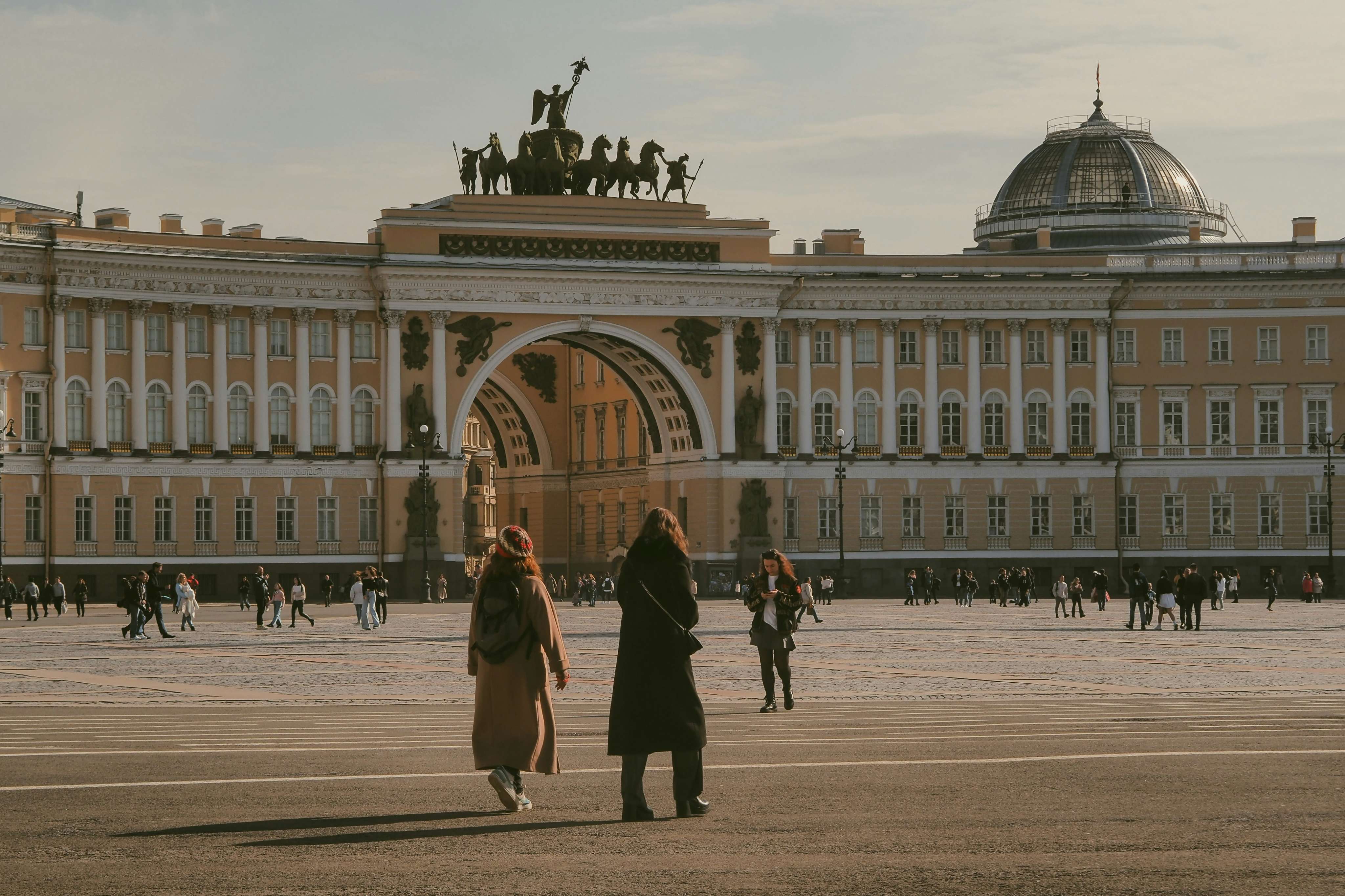
At the beginning of the 19th century there was no Palace Square as such. The Winter Palace had already been built, but the area around it was filled with scattered aristocratic houses. After the reconstruction of the Admiralty, by order of Alexander I, the city began buying up plots to create a unified ensemble for its central square. Carlo Rossi proposed building two blocks joined by an arch. The General Staff Building was erected to Rossi's design in 1819–1830.
The two blocks are joined by a long curved facade 580 meters (1,900 feet) long, considered a record for Europe when it was completed. Thanks to well-thought-out symmetry, the building does not look massive. And here Rossi's architectural genius showed itself: the parts of the building on different sides are of different lengths, set at an angle and asymmetrical, yet the architect managed to angle them so that this is not noticeable at all.
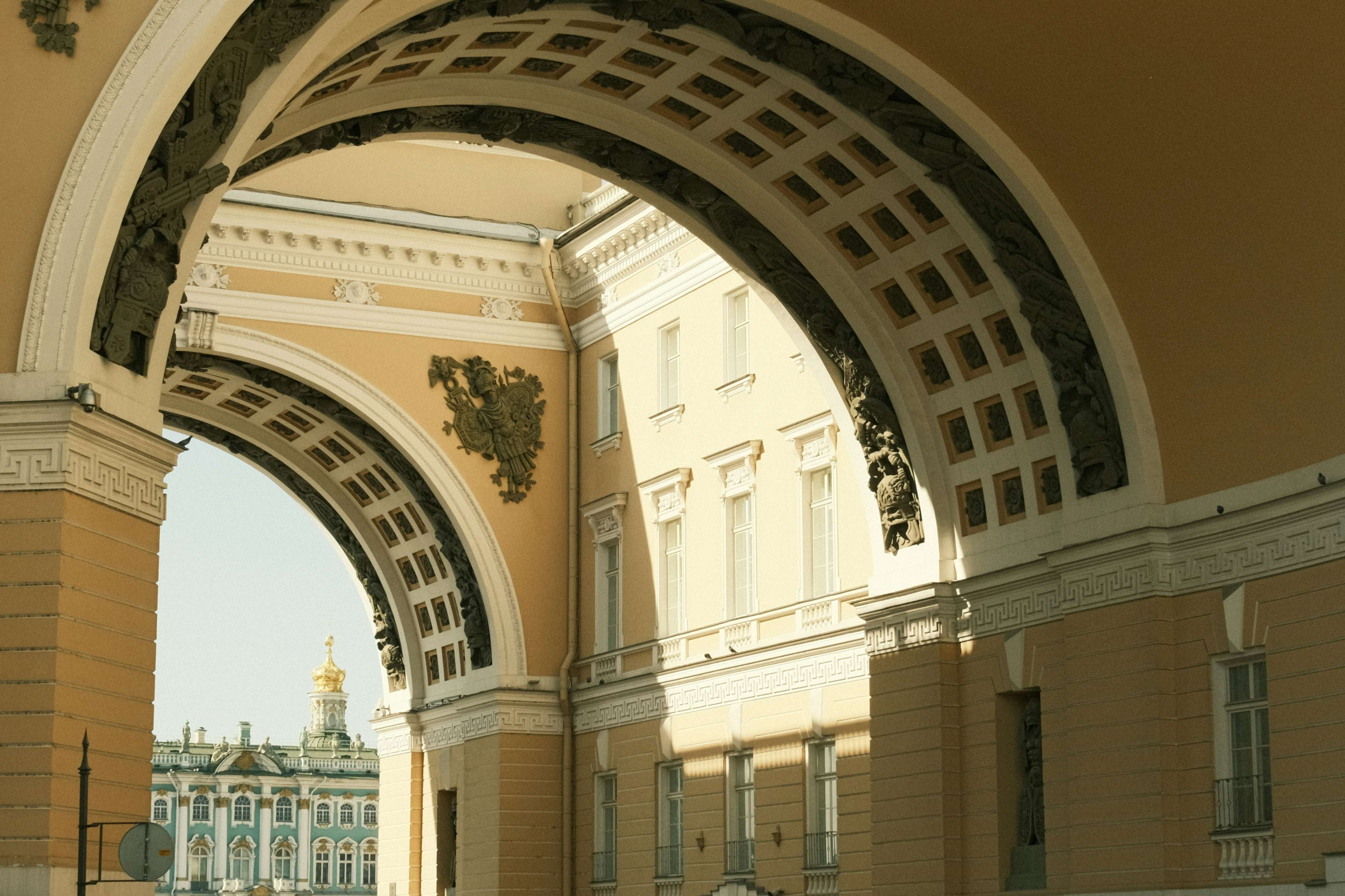
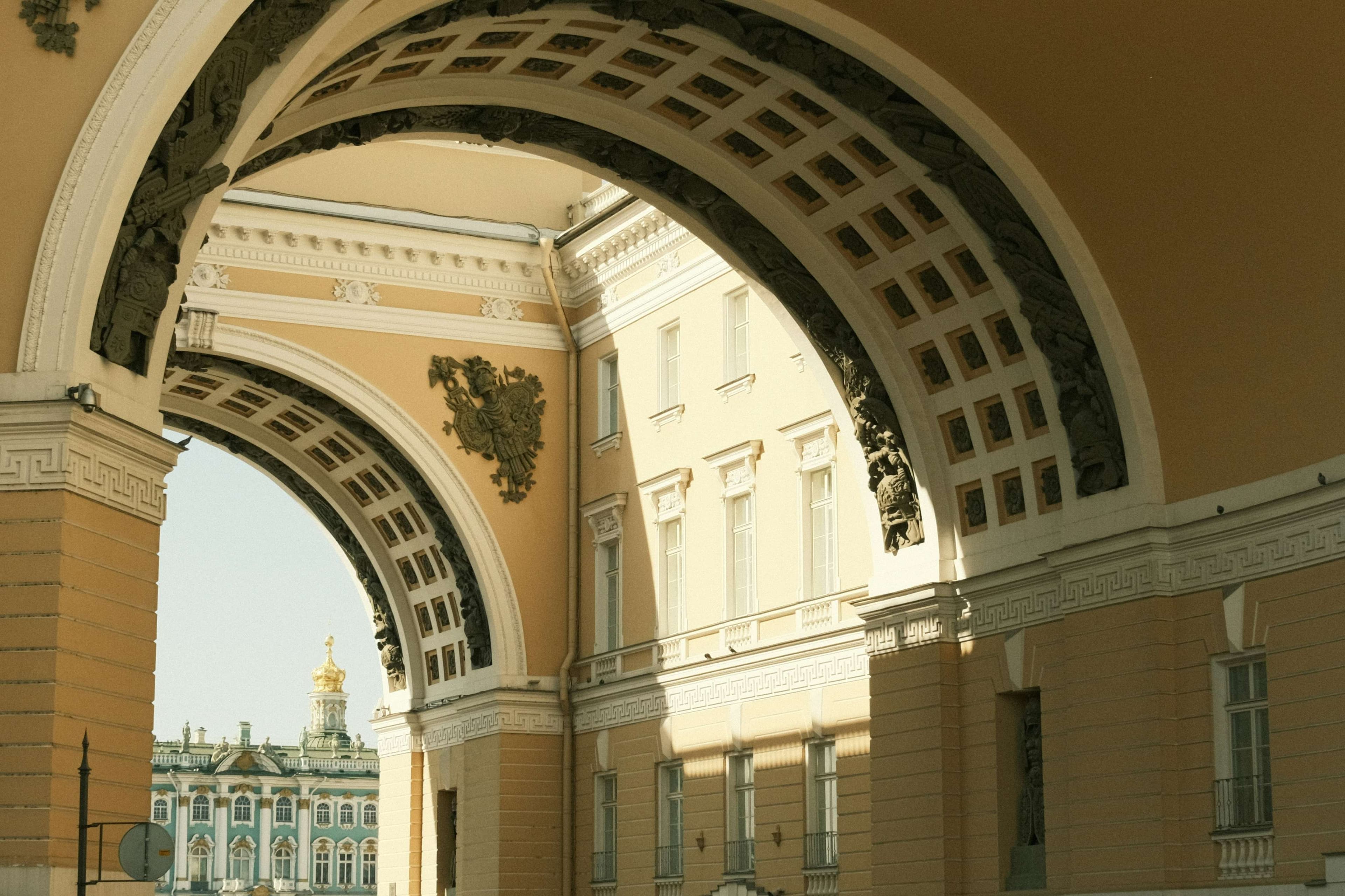
The central arch became the architectural focus of the whole ensemble and the ceremonial entrance to Palace Square. Rossi designed not one but three arches to soften the bend of the connecting street. The structure not only links the blocks but also supports their walls by bearing against them. It is 36 meters (118 feet) high. It is topped by a sculptural group: a chariot with the winged goddess of Glory (Nike). The General Staff Arch is dedicated to Russia's victory in the Patriotic War of 1812.
A Key View
It's hard to say for sure today why Carlo Rossi designed the General Staff Building with such an angled curve. One theory is that, since plots with existing buildings were being bought up at the time, the architect partly followed their layout. But it seems that what mattered more to Rossi was creating that very portal linking Nevsky Prospekt, Bolshaya Morskaya Street, and Palace Square.
If the arches and the passage beneath them had been built straight rather than at an angle, we would see the Winter Palace right from Nevsky Prospekt, and all the visual magic would simply dissolve. Instead the architect created a special portal of curved arches set at an angle. So Rossi's contemporaries and we today, in the 21st century, alike experience this cinematic effect. Turning off Nevsky Prospekt onto the pedestrian part of Bolshaya Morskaya Street, we come to the first arch. We admire the famous St. Petersburg clock. We pass under the arches, and only then, around the bend, does the dominant feature of the whole square appear before us: the Winter Palace, with the Alexander Column in the foreground.
Myths and Legends
The design of the General Staff arches was so unusual that at first it aroused mistrust among the people of St. Petersburg. They were afraid to walk under it. There is even a legend that when the scaffolding was being removed from under the main arch, Carlo Rossi climbed on top, meaning that if the arch failed and collapsed, he would go down with it. Naturally, all the arches held.
Nearby
The Alexander Column
If you come out onto Palace Square through the arch from Bolshaya Morskaya Street, you see that classic postcard view of the Winter Palace and the Alexander Column. The column, also called the Alexandrine Pillar, was erected in 1834 by the architect Auguste de Montferrand by order of Emperor Nicholas I, in memory of his elder brother Alexander I's victory over Napoleon. For inspiration Montferrand drew on the columns of Trajan and Antoninus in Rome, Pompey's Pillar in Alexandria, and the Vendôme Column in Paris, dedicated to Napoleon. The Alexander Column turned out taller than all of them, at 47.5 meters (156 feet).
To install the column, a foundation was laid, and a huge stone pedestal was placed on top of it. Then, to raise the column itself, they used the method of Agustín de Betancourt, which had been used in building St. Isaac's Cathedral: a special lifting system of scaffolding, capstans (devices for moving loads), and a system of pulleys. First the column was rolled up an inclined plane onto a special platform, and then the ropes attached at the top of the scaffolding began to raise it.
About 2,500 people raised the column in 40 minutes. The column stands on its granite base held only by its own weight, with no special supports.
 18 points
 7 km
 1.5 hours