Historical Background
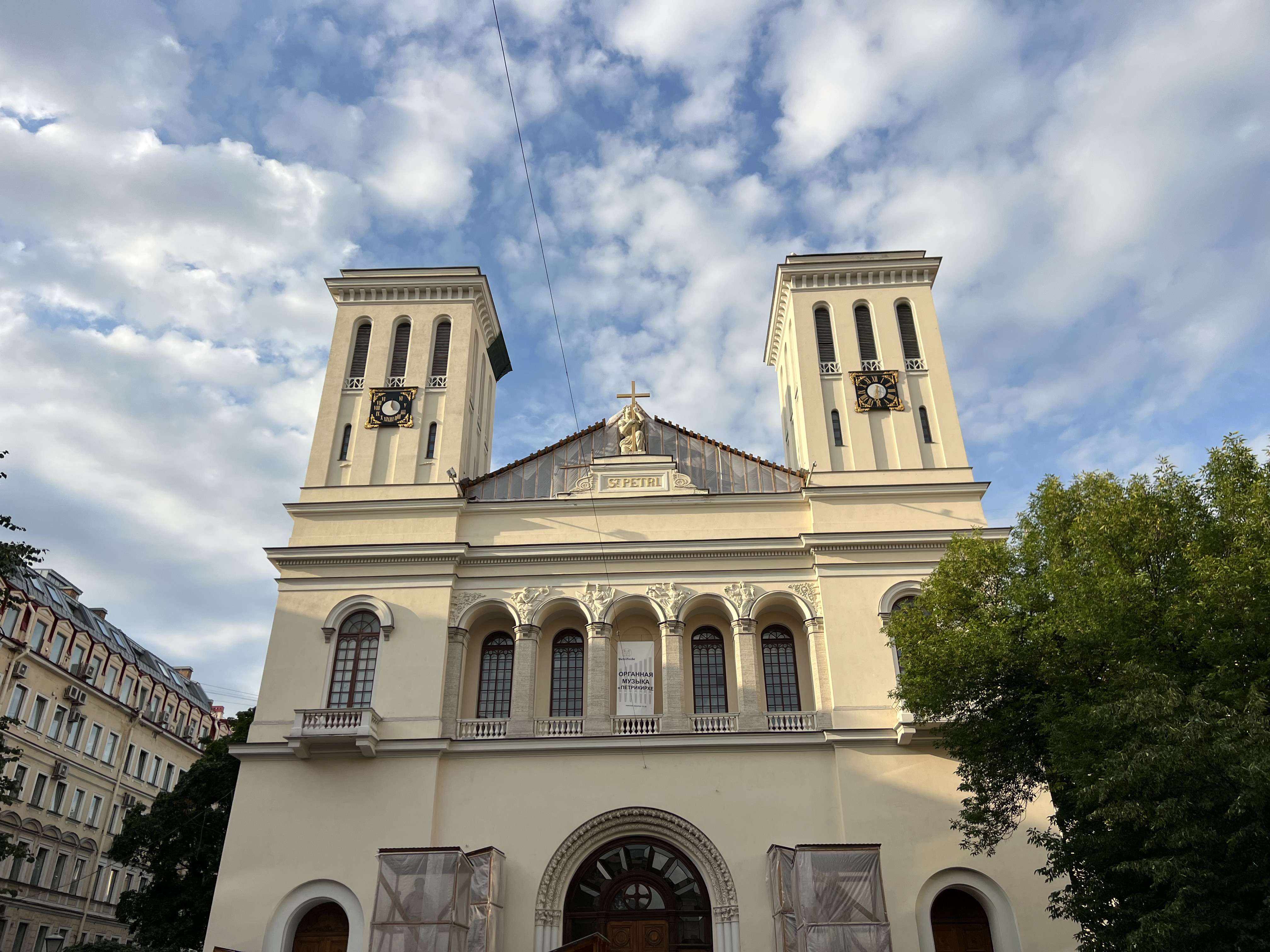
The Church of Sts. Peter and Paul is a Lutheran church in the center of St. Petersburg, yet another confirmation of how tolerant and open St. Petersburg and its main street have been to different nationalities and religions. Along Nevsky Prospekt, besides Orthodox churches, you can see a Catholic church, a Lutheran church, an Armenian church, and the building of the former Dutch church.
The Church of Peter and Paul, usually called simply the Petrikirche, came about thanks to Emperor Peter II. In 1727 he granted the German Lutheran community land for a Protestant church, a school, and a pastor's house. The church was founded in 1728 on the feast day of the apostles Peter and Paul. Two years later it was consecrated in the name of the apostles Peter and Paul, but in documents and among the townspeople the name of St. Peter was usually used. The first church was built in the style then customary, known as Petrine Baroque. Vivid examples of this style are the Kunstkamera and the Peter and Paul Cathedral inside the fortress of the same name.
In the first half of the 19th century the church building fell into disrepair, and the local Lutheran community announced a competition for the design of a new church. The winner was Bryullov, not the famous painter Karl but his brother Alexander.
The old church building was demolished in the summer of 1833, and on August 21 of that year the new one was founded. The church was built in 3 years, and finishing work continued for several more. The church received many interesting details. For example, the altar was adorned with a large painting of the Crucifixion by Karl Bryullov. Marble figures of the apostles Peter and Paul were placed in front of the church. In 1840 an organ by the famous firm Walcker was installed. Before the revolution the building was renovated several times, and then another chapter of its history began.
Panorama, Warehouse, Swimming Pool
After the revolution many parishioners emigrated from Petrograd, yet the Petrikirche remained open longer than the city's other Lutheran churches. It was closed in 1937, and then its trials began. The building was used to display the panorama “The North Pole.” It also served as a theater warehouse, and during World War II military units were stationed here.
After the war, in 1958, the building began to be converted into a swimming pool. A reinforced-concrete pool 25 meters (82 feet) long was built in the central nave, and diving towers were placed in the altar area. The pool opened in 1963.
Today
The building was returned to believers in 1993, but by then almost nothing remained of the church's original interior. Some elements survived: Karl Bryullov's altarpiece “The Crucifixion” is displayed in the Russian Museum, and the famous stained-glass windows ended up in the State Hermitage. But some of its valuable property has disappeared forever.
In the 1990s the church was renovated, but its original appearance could not be restored. The brick vaults were reinforced with the metal columns of a new floor structure, and the new floor was laid 4 meters (13 feet) above the old one; the concrete basin of the pool is still underneath. Removing it would require a major reconstruction and a project to reinforce the load-bearing structures. In 2016–2019 the city paid for the restoration of the church's facade and of the sculpture of an angel with a cross that crowns it. In 2017 a new organ was installed in the Petrikirche, and organ concerts are now held here regularly.
Nearby
Smirdin's Former Bookshop
Almost 200 years ago, Smirdin's famous bookshop was at 22 Nevsky Prospekt. Many of Russia's literary stars visited it: Pushkin, Krylov, Gogol, Zhukovsky. Today the only reminder of the bookshop is a memorial plaque on the wall of the building.
Bolshaya Konyushennaya Street
A famous promenade street. It's pleasant to stroll here under the lindens. Street musicians often play at the intersection of Bolshaya Konyushennaya and Nevsky. The street is home to the famous DLT, the Leningrad House of Trade. And Bolshaya Konyushennaya also has St. Petersburg's most famous pyshechnaya (doughnut shop), where there is a line out the door at almost any time of year. They make traditional Leningrad pyshki (doughnuts) here, and a Soviet-era doughnut-making machine has survived. That's why people line up: not so much for any special taste as for the atmosphere. Traditional pyshki and urn-brewed coffee with milk.
 18 points
 7 km
 1.5 hours