Historical Background
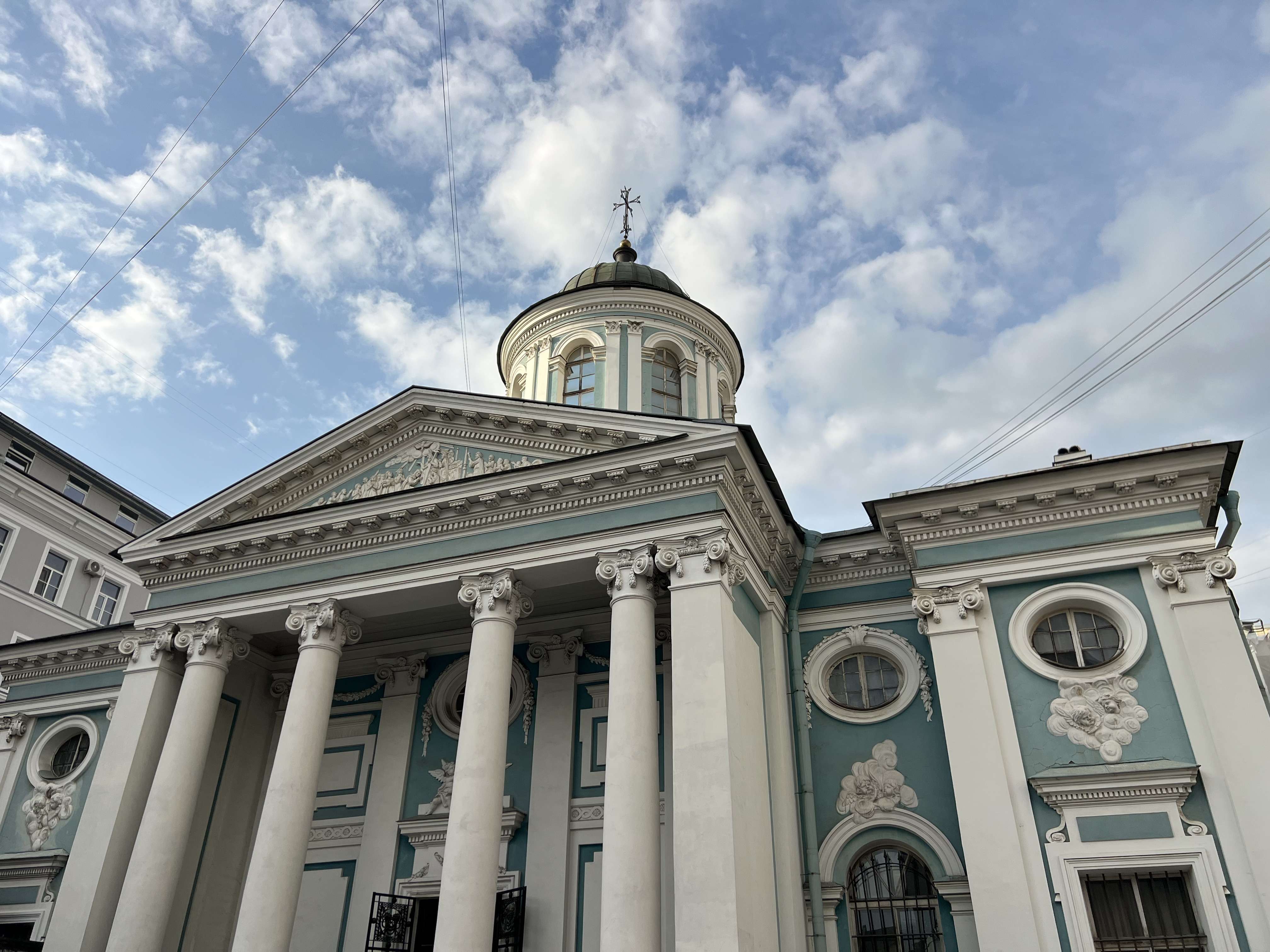
The first Armenian community appeared in the city almost immediately after its founding. As early as 1714 the Armenian community petitioned the authorities to build a church, but was refused. In 1740 the community received permission and even began construction, but a few years later the permission was revoked. In 1770, following a petition from the head of the Armenian community, I. L. Lazarev, Catherine II gave verbal permission for the construction. The church opposite Gostiny Dvor was built by Felten, a fashionable architect of the time, as befitted the ceremonial splendor of the capital's center. Lazarev personally donated most of the money for its construction.
Who Was Lazarev?
The official history will give you dry facts about Ivan Lazarev and the building of the church. But he was born Hovhannes Lazarian, and thanks to his talents and his family of jewelry merchants he built a successful career: he became one of the richest men of the Catherine era, a court jeweler from 1764, and later an adviser to the empress.
Lazarev-Lazarian is linked to the story of the legendary Orlov Diamond. According to the official version, Count Orlov, the empress's favorite, bought the diamond and presented it to her as a gift. According to a less official version, Lazarev-Lazarian, who knew the jewelry business inside out, had a direct hand in the purchase, for which he was brought close to the highest figures in the state. According to the most original version, the empress herself wanted to buy the diamond, and to avoid awkward questions about spending from the treasury, the story of Count Orlov's gift was invented. The involvement of an experienced jeweler, who was then generously rewarded, fits easily into this version too. And later he would donate a considerable sum to build the church. In any case, Lazarev was close to the empress, rose steadily up the career ladder, and in 1788 even received the title of count.
Today you can admire the famous Orlov Diamond in the Diamond Fund of the Moscow Kremlin.
The Armenian Church
In 1780 the church was consecrated in the name of the Great Martyr Catherine, the empress's heavenly patron, and became the center of Armenian culture in St. Petersburg. A printing house and a national school were opened here. Over its history the church was rebuilt several times and had a hard fate after the revolution. But the building itself has survived, serves its original religious purpose today, and is one of the many churches of different faiths along Nevsky Prospekt.
Nearby
The Passage Department Store
Next to the Armenian church is a famous department store, one of the oldest covered shopping arcades in Europe. It opened in 1848. In the second half of the 19th century the building served various functions; for example, one of its halls hosted the evenings of the Literary Fund, where Dostoevsky, Turgenev, Nekrasov, Chernyshevsky, and Shevchenko appeared. At the turn of the 20th century the building was rebuilt and left with only its retail function. In Soviet times the Passage became a state department store, and today it is once again home to private shops in a stunning architectural setting.
 18 points
 7 km
 1.5 hours