←Getting to Know St. Petersburg

Getting to Know St. Petersburg

Photo of route “Getting to Know St. Petersburg”
18 points7 km1.5 hours

In the city on the Neva, luxurious palaces, world-class museums, old cathedrals, and cozy embankments blend in perfect harmony. This route will highlight the city's main sights, along with some of its secrets and legends.

Things to do

  • 📸 Take photos
  • 📜 Learn the city's history
  • 🏰🕵️‍♂️ Discover a legend

Route points (18)

  1. Anichkov Bridge and Palace — point on route “Getting to Know St. Petersburg”

    Anichkov Bridge and Palace

    📜 Historic site · 🏰 Palace · 🌉 Bridge

  2. Ostrovsky Square — point on route “Getting to Know St. Petersburg”

    Ostrovsky Square

    📜 Historic site · 🗿 Monument · ⛲ Square

  3. Eliseev Brothers Trading House — point on route “Getting to Know St. Petersburg”

    Eliseev Brothers Trading House

    🏟️ Architectural landmark · 📜 Historic site · 🕵️ Urban legend

  4. Armenian Church of St. Catherine — point on route “Getting to Know St. Petersburg”

    Armenian Church of St. Catherine

    🕍 Place of worship · 🕵️ Urban legend · 📜 Historic site

  5. Gostiny Dvor (Merchant Arcade) — point on route “Getting to Know St. Petersburg”

    Gostiny Dvor (Merchant Arcade)

    📜 Historic site · 🏟️ Architectural landmark · 🏺 Market / bazaar

  6. Shostakovich Philharmonia — point on route “Getting to Know St. Petersburg”

    Shostakovich Philharmonia

    🕵️ Urban legend · 📜 Historic site · 🎭 Theater

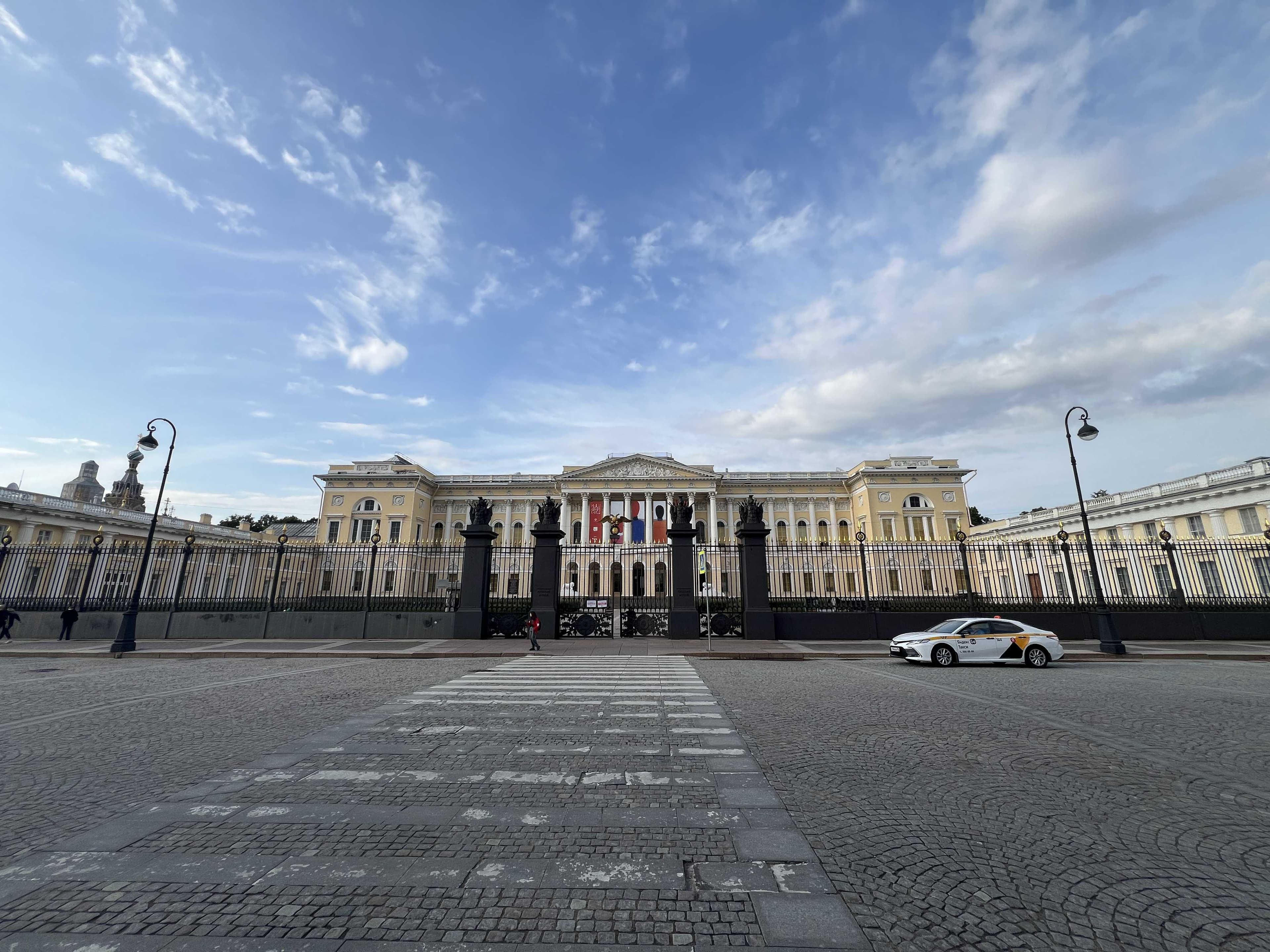
  7. Mikhailovsky Palace (Russian Museum) — point on route “Getting to Know St. Petersburg”

    Mikhailovsky Palace (Russian Museum)

    🏛️ Museum · 🏰 Palace · 📜 Historic site

  8. Singer Company Building — point on route “Getting to Know St. Petersburg”

    Singer Company Building

    🏟️ Architectural landmark · 🕵️ Urban legend · 🔭 Viewpoint

  9. Kazan Cathedral — point on route “Getting to Know St. Petersburg”

    Kazan Cathedral

    🕍 Place of worship · 📜 Historic site · 🏟️ Architectural landmark

  10. Petrikirche (Church of Sts. Peter and Paul) — point on route “Getting to Know St. Petersburg”

    Petrikirche (Church of Sts. Peter and Paul)

    🕍 Place of worship · 🕵️ Urban legend · 📜 Historic site

  11. Stroganov Palace — point on route “Getting to Know St. Petersburg”

    Stroganov Palace

    🏰 Palace · 📜 Historic site · 🏛️ Museum

  12. Wawelberg House — point on route “Getting to Know St. Petersburg”

    Wawelberg House

    🏟️ Architectural landmark · 📜 Historic site · 🕵️ Urban legend

  13. General Staff Arch — point on route “Getting to Know St. Petersburg”

    General Staff Arch

    📜 Historic site · 🏟️ Architectural landmark · 🕵️ Urban legend

  14. Palace Square — point on route “Getting to Know St. Petersburg”

    Palace Square

    ⛲ Square · 🏰 Palace · 📜 Historic site

  15. The Admiralty — point on route “Getting to Know St. Petersburg”

    The Admiralty

    📜 Historic site · 🏟️ Architectural landmark · 🕵️ Urban legend

  16. The Bronze Horseman — point on route “Getting to Know St. Petersburg”

    The Bronze Horseman

    🗿 Monument · 🕵️ Urban legend · 🗿 Sculptures

  17. St. Isaac's Cathedral — point on route “Getting to Know St. Petersburg”

    St. Isaac's Cathedral

    🕍 Place of worship · 🕵️ Urban legend · 📜 Historic site

  18. House at the Red Bridge — point on route “Getting to Know St. Petersburg”

    House at the Red Bridge

    🏟️ Architectural landmark · 🕵️ Urban legend · 🌉 Bridge

Mikhailovsky Palace (Russian Museum) in Saint Petersburg

Point on route “Getting to Know St. Petersburg”

Mikhailovsky Palace (Russian Museum) — point on route “Getting to Know St. Petersburg”

Point 7

Mikhailovsky Palace (Russian Museum)

🏛️ Museum • 🏰 Palace • 📜 Historic site

How It Was Created

The Mikhailovsky Palace is another famous creation of the architect Carlo Rossi, and not just a palace but a full architectural ensemble. In the early 19th century Rossi designed a square near Nevsky Prospekt and a number of buildings on it. Today we know them as Arts Square, the Mikhailovsky Palace (the main building of the Russian Museum), the Mikhailovsky Theater, the Grand Hall of the Shostakovich Philharmonia, and the Hotel Europe. All of this was designed as a single ensemble. The square and the Mikhailovsky Palace were built for Grand Duke Mikhail Pavlovich, the fourth son of Paul I and Maria Feodorovna and the younger brother of Emperors Alexander I and Nicholas I. The palace was built in 1819–1825 in the late Classical, or Russian Empire, style. The idea came from the grand duke's father, Emperor Paul I. He understood that his youngest son was not destined to take the throne. Paul I ordered money to be set aside every year to build a palace, “so that my son, on coming of age, may at least live like a tsar.” Paul I himself did not live to see the plan realized, because of the palace coup and his murder. But in 1819, when Grand Duke Mikhail turned 21, the new emperor, Mikhail's elder brother Alexander I, carried out their father's wish and began construction.

Building the Mikhailovsky Palace

By then design work was already under way. The project was overseen by the government official Betancourt, who brought Carlo Rossi in to design it. Originally the Mikhailovsky Palace might have appeared elsewhere in St. Petersburg: the sites considered included where the Vorontsov Palace now stands and the place where the Mariinsky Palace would later be built. Rossi and Betancourt proposed a more ambitious project: the reconstruction of a large area between Nevsky Prospekt, the Fontanka, and Sadovaya Street. To make room, the orangeries and hotbeds in the former gardens of the Mikhailovsky Castle were demolished. The Mikhailovsky Palace was completed in 1823, when an imperial decree granted it to the grand duke “in perpetual and hereditary possession.” The interior decoration took another two years. The architect Carlo Rossi was awarded the Order of St. Vladimir, 3rd class. And two centuries later, residents and visitors still admire the architectural ensemble of Arts Square.

The Russian Museum

After the grand duke's death, his wife and children lived in the Mikhailovsky Palace. In 1894 Mikhail Pavlovich's grandchildren sold the palace to the treasury, and in 1895 the Russian Museum of Emperor Alexander III was founded here. Since 1917 it has been called the State Russian Museum. Today the Mikhailovsky Palace is the main branch of the Russian Museum, whose branches are scattered all over the city.

Nearby

The Mikhailovsky Theater, the Garden, and the Pushkin Monument Arts Square is a complete architectural ensemble with many iconic cultural venues. For example, the Mikhailovsky Theater is here, and the Musical Comedy Theater is nearby. At the center of Arts Square there was originally a small garden, where a monument to Pushkin was erected in 1957.